
Theory of Tubing
and Rod Wear
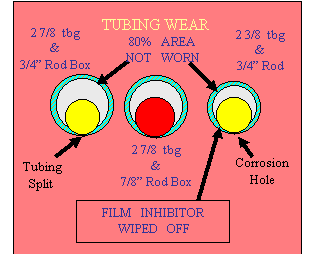 The
action of reciprocating or rotating the rods within a pumping well causes wear
of the rod string against the tubing (Figure shows relative sizes of rod boxes
in 2-3/8 & 2-7/8 in. tubing with contact area shown and two failure
mechanisms). The deviations of a hole will severely increase the sideways force
that increases the friction (drag) between the rods and tubing. However, even “straight
holes” will have significant wear because (1) tubing or rods will lay to
the side of the hole (very little room between rod couplings and tubing) and
(2) the buckling action of the rods due to the downstroke or whipping action of
the rotating rods. This leads to failures in “crooked holes” to sometimes be in
the order of months (with new tubing), to several years in “perfectly” straight
holes.
The
action of reciprocating or rotating the rods within a pumping well causes wear
of the rod string against the tubing (Figure shows relative sizes of rod boxes
in 2-3/8 & 2-7/8 in. tubing with contact area shown and two failure
mechanisms). The deviations of a hole will severely increase the sideways force
that increases the friction (drag) between the rods and tubing. However, even “straight
holes” will have significant wear because (1) tubing or rods will lay to
the side of the hole (very little room between rod couplings and tubing) and
(2) the buckling action of the rods due to the downstroke or whipping action of
the rotating rods. This leads to failures in “crooked holes” to sometimes be in
the order of months (with new tubing), to several years in “perfectly” straight
holes.
This wear action is very important, because it is
often the culprit of several types of failures: (1) tubing splits, (2)
corrosion holes & pits, (3) rod box failure, and (4) rod body failure. The
proper diagnosis and documentation of these problems is important to improve
the run time of pumping wells. The mechanisms 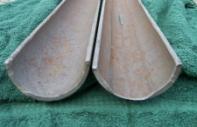 of
these failures related to wear are:
of
these failures related to wear are:
S A “tubing split” is often accomplished by the tubing being worn thin and smooth on one side (usually a straight path being 20% of the circumferential area and the length of the pump stroke) until the pressure in the tubing blows a hole in the tubing. The picture on the right shows a thin smooth section on the right half of the tubing with a split at the top{a rod box would fit nicely in the worn area with 80% of the area not worn at all}. The TSR spreads this wear over the entire circumference to extend run times by potentially 500%.
S “Corrosion
hole or pitting” occurs because of (a)“poor chemical selection or application”
or (b) more often when the inhibitor is wiped off by wear allowing
corrosion to occur. This “wiping off of inhibitor” is accomplished by (1) the
internal wear from rods or rod guides, or (2) externally by tubing expansion
(unanchored tubing). Analysis involves determining either: (1) corrosion is
occurring around the entire circumference due to “poor chemical treatment or
selection”, or (2) pitting is occurring along an area wiped free of inhibitors
(termed “Corrosion Due to Wear”). This “Corrosion Due to Wear” is
indicated by a roughly straight line of pitting along an area of minor or
severe wear (similar to a “tubing split” but wear pattern is not smooth). 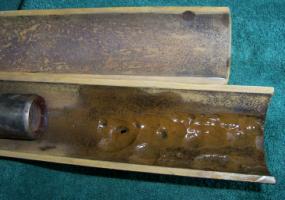 This
wear area is usually about (a) 20% of the circumference for internal wear with
no rod guides (30% with certain rod guides), or (b) 20% of external tubing
circumference from tubing movement (while pumping without tubing anchor). The
Figure to the left shows severe pitting along the width of a rod box (tubing
was wetted for enhancement), which also was thinner
This
wear area is usually about (a) 20% of the circumference for internal wear with
no rod guides (30% with certain rod guides), or (b) 20% of external tubing
circumference from tubing movement (while pumping without tubing anchor). The
Figure to the left shows severe pitting along the width of a rod box (tubing
was wetted for enhancement), which also was thinner 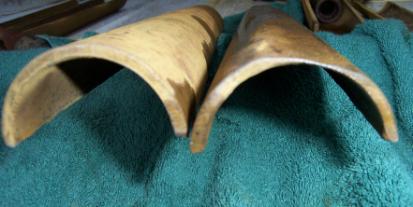 above
and along the pitting area (indicating wear wiping off inhibitor since the rest
of tubing has very minor corrosion). The Figure to the right shows tubing with external
wear with pitting along 20% of the tubing’s circumference (I.D. is the same but
O.D. is worn along a straight line indicating tubing wear against casing
(unanchored tubing).
above
and along the pitting area (indicating wear wiping off inhibitor since the rest
of tubing has very minor corrosion). The Figure to the right shows tubing with external
wear with pitting along 20% of the tubing’s circumference (I.D. is the same but
O.D. is worn along a straight line indicating tubing wear against casing
(unanchored tubing).
This “Corrosion Due to Wear” mechanism will not normally be solved by (a) installing rod guides and/or (b) redesigning the chemical program (if 80% of area is unpitted, then the problem is not normally due to chemical type or treatment method). Intermittent rotation with a TSR spreads out the corrosion area to reduce the frequency of the corrosion failures (5 times more metal to corrode around the circumference since the old wiped off area should be coated with inhibitor after the tubing is turned). Automatic continuous tubing rotation may immediately wipe off the inhibitor and is not recommended if “Corrosion due to Wear” failures occur. This “Corrosion due to Wear” failure mechanism (absent in some “failure literature”) is a common occurrence since many wells are treated with inhibitors to minimize corrosion rates. Unfortunately, many “unsuccessful” chemical programs may actually be adequate, but the wiping off of inhibitors by wear causes corrosion holes and lead to unsuccessful attempts to modify the chemical program.
S A “rod box failure due to wear” will often have one side of the box worn down until the box fails. Rod guides, which are continuously replaced, may temporarily correct this at the expense of increasing rod stresses and the circumferential area for corrosion (certain rod guides may wipe off inhibitor from a larger area). One solution is to install Spray Metal Alloy boxes, which are less corrosive and “smoother” (reduces friction and wear) and are very hard to wear down. With less friction and tubing rotation, the service life may be substantially improved.
S A “rod body failure due to wear” will often have one side of the rod body worn down until the body fails due to tension, particularly in deviated wells. This is often temporarily corrected or delayed by Rod Guides. This is not as big a problem in relatively straight wells because most wear occurs at the rod box site.
Thus, if the pumping well is properly designed, the prevalent failure mechanism will normally be Wear or Corrosion Due to Wear (often 40 to 80% of the failures). This failure mechanism can be delayed by 400% to 900% by rotating the tubing. Less run time improvement may be expected from the use of the more expensive continuous rotating heads since they could be wiping off the corrosion inhibitors and thereby not helping the “Corrosion Due to Wear” failure mechanism.
SUMMARY
Omega Technologies Inc. provides a Tubing Saver Rotator, patent pending, (TSR) that provides an economical way to substantially reduce the repair costs of pumping wells. By lowering operating costs and reducing production downtime, the economics of each well may be significantly improved, which extends reserve life. The TSR is designed to potentially be a high Rate of Return Investment (40% to 100% for wells failing more often then every 2 years) with minimal complications in the use of the TSR. Even marginal wells can afford the TSR and keep reaping the benefits of lower operating costs and increased yearly production with the proper usage of the TSR. The actual documentation of failure types and causes is recommended to enable proper selection of techniques to improve pumping performances in the oil and gas industry.