

INSTALLATION, USAGE, and
REPAIR
 INSTALLATION:
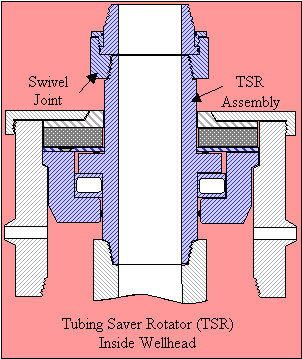
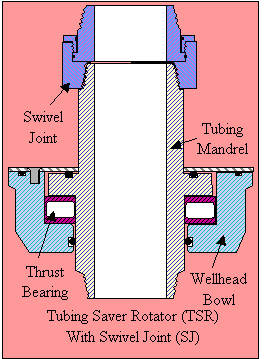
The TSR is one unit installed during a pulling job (see drawing). The Rig will have a pin end sticking up and a pin end sticking down on the TSR Tubing Mandrel. The Rig should:
1. Make up the bottom pin end to the Tubing.
2. Lower the Mandrel and Bowl into the wellhead until it seats on shoulder within wellhead.
3. Pack off wellhead with normal rubber and plate.
4. Attach the Swivel (one can leave on Pump Tee on future pulls).
5. Make up the Pump Tee.
6.
Install 6’ or 12’ pony rod immediately above pump (longer
than stroke). Add or remove another pony above pump on future pulls.
USEAGE
The Mandrel is designed to be stronger than J-55 tubing
while maintaining a Rockwell Hardness of C22 or lower (To minimize H2S stress
cracking). Different metallurgy may be available for high strength or severe
corrosive situations. The TSR is designed to be turned easily with 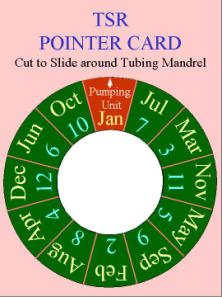 one
person using a pipe wrench. The pumper or treater procedure may:
one
person using a pipe wrench. The pumper or treater procedure may:
1. Insure Safe Operation when turning rotator by inspecting area and using proper safety precautions.
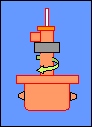
2. Grab hold of the bottom part of the swivel or on the tubing mandrel.
3. Rotate the Tubing Clockwise. Then pump chemical inhibitors (if applicable)
4. A “Pointer” is made up on the swivel or mandrel to guide rotation of the TSR. Commonly, this pointer is rotated relative to a laminated “Pointer Card” that a person could carry. One Part of the Round Card has an area to point at the Pumping Unit. Months or Numbers are then marked on the card to show relative position at which the pointer should be set on after rotation. If the Date were January, then the “Pointer” would be pointing at the Pumping Unit, while April would have the pointer aligned about 240o clockwise from the Pumping Unit (the eight o’ clock position).
5. Once a person turns a few wells, then they will know where to turn the “Pointer” on the Swivel without rechecking the Card or an operator may prefer to have the person rotate ¼ turn every time.
6. This method allows one to check to see if the rotator is being turned by anyone with a card (supervision check).
7. If the wellhead leaks, then the operator can tighten down the dognut or replace the rubber element without a rig.
It is recommended to have the tubing rotated immediately before doing a batch chemical treatment down the casing. This will allow inhibitor to coat the clean area that was previously wiped off due to wear from rods or rod guides. If the tubing is rotated after a batch job, then part of the tubing will not have an inhibitor film. The automatic rotators wipe off inhibitor over 100% of the circumference and therefore do not benefit failures due to corrosion holes like manual rotation may.
REPAIR
 Repair
of the TSR mandrel assembly is easily accomplished if ever needed. There are
three O-Rings in the TSR Bowl assembly. The top two O-Rings can be changed by
one person removing the Bowl Plate and inserting new O-Rings. The bottom O-Ring
will require a rig to pull the TSR from the well as will replacement of the
thrust bearing. Failure of the O-Rings is not critical and may only allow
fluids to enter into the bearing housing area and thereby lead to future
corrosion of some of the elements (Bearing, bowl, and mandrel). However, O-Ring
failure normally should not immediately hurt the rotation of the tubing or
allow fluids to exit the wellhead since the wellhead fluids are usually sealed
with the top rubber element. When the tubing is to be pulled, one should
inspect the rotator for any potential repairs.
Repair
of the TSR mandrel assembly is easily accomplished if ever needed. There are
three O-Rings in the TSR Bowl assembly. The top two O-Rings can be changed by
one person removing the Bowl Plate and inserting new O-Rings. The bottom O-Ring
will require a rig to pull the TSR from the well as will replacement of the
thrust bearing. Failure of the O-Rings is not critical and may only allow
fluids to enter into the bearing housing area and thereby lead to future
corrosion of some of the elements (Bearing, bowl, and mandrel). However, O-Ring
failure normally should not immediately hurt the rotation of the tubing or
allow fluids to exit the wellhead since the wellhead fluids are usually sealed
with the top rubber element. When the tubing is to be pulled, one should
inspect the rotator for any potential repairs.