
 TUBING
SAVER ROTATOR
TUBING
SAVER ROTATOR
(TSR, Patent Pending)
Reduces Tubing
Failures by 83%
 Omega
Technologies Inc. has developed the innovative Tubing Saver Rotator (patent
pending), TSR, to substantially reduce the number of failures in pumping
wells by 75% to 90% (4 to 10 times the life between failures). A majority of pumping
failures is due to the wearing of the rods or rod guides on about 20% of the
tubing’s circumference (causing tubing splits or “Corrosion due to Wear”). The
TSR distributes this wear pattern over the entire tubing’s circumference (5
times the area to wear down). This is accomplished by the TSR allowing one
person to manually rotate the tubing string about once per month or quarter
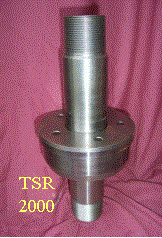
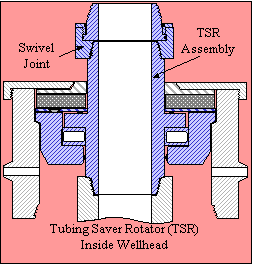
with a pipe wrench. It consists of a bowl that sits below the wellhead and
houses a thrust bearing to hold all the tubing weight (in lieu of slips) on a
tubing mandrel with a swivel located between the wellhead and pump tee. The TSR
is priced to be roughly the cost of one average tubing failure repair job,
which enables Rate of Returns between 40% and 100% to be achieved for wells
failing more than once every 24 months. Thus, the TSR is an excellent
investment for wells with an average or poor run time between failures. This
easily and quickly installed mechanism should be the preferred investment
before rod guides are installed and the corrosion program changed (see Theory
of Tubing Wear).
Omega
Technologies Inc. has developed the innovative Tubing Saver Rotator (patent
pending), TSR, to substantially reduce the number of failures in pumping
wells by 75% to 90% (4 to 10 times the life between failures). A majority of pumping
failures is due to the wearing of the rods or rod guides on about 20% of the
tubing’s circumference (causing tubing splits or “Corrosion due to Wear”). The
TSR distributes this wear pattern over the entire tubing’s circumference (5
times the area to wear down). This is accomplished by the TSR allowing one
person to manually rotate the tubing string about once per month or quarter
with a pipe wrench. It consists of a bowl that sits below the wellhead and
houses a thrust bearing to hold all the tubing weight (in lieu of slips) on a
tubing mandrel with a swivel located between the wellhead and pump tee. The TSR
is priced to be roughly the cost of one average tubing failure repair job,
which enables Rate of Returns between 40% and 100% to be achieved for wells
failing more than once every 24 months. Thus, the TSR is an excellent
investment for wells with an average or poor run time between failures. This
easily and quickly installed mechanism should be the preferred investment
before rod guides are installed and the corrosion program changed (see Theory
of Tubing Wear).
HISTORICAL PERFORMANCE
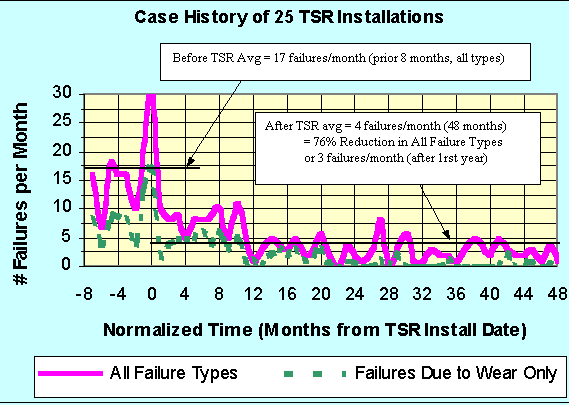
Several failure mechanisms are present in a pumping well, but are normally related to (1) Wear, (2) Corrosion, (3) Stress on rods, (4) Pump Failure, and (5) Other miscellaneous categories (sand, paraffin, scale, etc.). Wear is the principal culprit in most pumping operations in wells with a proper downhole design and proper installation (see Theory of Tubing and Rod Wear). The TSR theoretically should reduce the number of these failures by 75% to 90%, which corresponds to extending the run time between failures by 300 to 900%. In 25 wells installed with the TSR equipment for 4 years, the run time was improved by 313% (76% reduction) for all failure mechanisms (wear, stress, scale, etc.). These same wells saw the run time between failures due to Wear only (Tubing Splits or Corrosion Hole due to Wear) increase by 484% (83% reduction).
 An
experiment was performed in a large oil field (1200 rod pumped oil producers)
to reduce failures. The worst performing 25 wells were installed with the TSR
equipment from 1996 to 1998 with significant improvements (see Table 1 below).
The average run time between failures was improved from 1.5 months (8 month
average) to 6.1 months per well (48 month average) with further improvement to
9 months per well 1 year after installation. This improvement yielded a 100%
Rate of Return (ROR) and a 3-month payout. In addition, this 76% reduction
(4.1 times the life) is for all failure types (not just wear related, but also
includes rod parts, stuck pumps, etc.). If one only considered wear related
failures, the average run time per well was improved from 3 months to 16 months
(an 83% reduction or 6 times the life). Thus, it appears one could assume that
the TSR could extend the life between failure repairs by 4 to 6 times. These
savings generate around 40% to 100% Rate of Returns for wells that fail
at least once every two years or more often (assuming the TSR cost is equal to
one repair cost). Thus, the TSR is applicable for the average well and the
problem wells.
An
experiment was performed in a large oil field (1200 rod pumped oil producers)
to reduce failures. The worst performing 25 wells were installed with the TSR
equipment from 1996 to 1998 with significant improvements (see Table 1 below).
The average run time between failures was improved from 1.5 months (8 month
average) to 6.1 months per well (48 month average) with further improvement to
9 months per well 1 year after installation. This improvement yielded a 100%
Rate of Return (ROR) and a 3-month payout. In addition, this 76% reduction
(4.1 times the life) is for all failure types (not just wear related, but also
includes rod parts, stuck pumps, etc.). If one only considered wear related
failures, the average run time per well was improved from 3 months to 16 months
(an 83% reduction or 6 times the life). Thus, it appears one could assume that
the TSR could extend the life between failure repairs by 4 to 6 times. These
savings generate around 40% to 100% Rate of Returns for wells that fail
at least once every two years or more often (assuming the TSR cost is equal to
one repair cost). Thus, the TSR is applicable for the average well and the
problem wells.
TABLE 1: Case
History of 25 Wells installed with the TSR for 4 years
|
|
All Failures Types (#Repairs/yr) |
Run Time for all Failure Types (Months) |
Wear related failures (#Repairs/yr) |
Run Time for Wear related failures only (months) |
|
Before TSR |
203 |
1.5 |
108 |
2.8 |
|
After TSR |
49 |
6.1 |
18 |
16.2 |
|
Improvement |
313 % |
313 % |
484 % |
484 % |
|
Reduction |
76 % |
76 % |
83 % |
83 % |