

SIDESTREAM FLUSH RESTRICTOR
(SFR, Patent Pending)
Reduces
Electricity and Pumping Failures
 Omega
Technologies Inc. has developed the innovative Sidestream Flush Restrictor (SFR,
Patent Pending) to save pumping energy costs (electricity or fuel), improve
chemical performance, and reduce pumping failure frequency. The SFR (patent pending) restricts the
sidestream flush flow of wellhead fluids into the annulus for mixing with
continuous chemical injection through the use of a small diameter Restrictor
Line and a filter (in lieu of the conventional needle valve choke arrangement).
This technique allows sidestream flush volumes to be significantly reduced
while also reducing the chance of small particles plugging up the conventional
needle valve arrangement. In actual field tests, the sidestream fluid rates
were reduced from an average of 75 bpd to 10 bpd, which saved around 625
kilowatts of electricity on 700 wells utilizing continuous chemical injection.
In addition, failure rates were reduced since (a) the pumping units were slowed
down to account for the reduced sidestream flush rates and (b) improved
chemical operation (less plugging and freezing of the flush line).
Omega
Technologies Inc. has developed the innovative Sidestream Flush Restrictor (SFR,
Patent Pending) to save pumping energy costs (electricity or fuel), improve
chemical performance, and reduce pumping failure frequency. The SFR (patent pending) restricts the
sidestream flush flow of wellhead fluids into the annulus for mixing with
continuous chemical injection through the use of a small diameter Restrictor
Line and a filter (in lieu of the conventional needle valve choke arrangement).
This technique allows sidestream flush volumes to be significantly reduced
while also reducing the chance of small particles plugging up the conventional
needle valve arrangement. In actual field tests, the sidestream fluid rates
were reduced from an average of 75 bpd to 10 bpd, which saved around 625
kilowatts of electricity on 700 wells utilizing continuous chemical injection.
In addition, failure rates were reduced since (a) the pumping units were slowed
down to account for the reduced sidestream flush rates and (b) improved
chemical operation (less plugging and freezing of the flush line).
 Continuous
chemical injection in a pumping operation (Rod Pumps, PCPs, Submersible pumps)
normally requires a portion of the producing wellhead fluids (Sidestream Flush)
to be mixed with chemical and placed back down the tubing annulus. The sidestream
flush rates are normally restricted by a needle valve or ¼ in. valve. However,
chemical operations normally require only 5 to 10 barrels per day (BPD) of
sidestream flush, which would require around a 0.025-inch orifice diameter
equivalent in the choke. In practice, the operator will often choke the well
back to a point where the needle valve will hopefully not plug up (from sand,
scale, or other particles), which often results in a larger choked flow area
and high sidestream flush rates. In actual field tests, around 300 wells
(at +/- 1600 feet) were found to have sidestream flush rates averaging 75 bpd
per well. An SFR design was implemented to restrict fluids to around 10 bpd per
well, which resulted in saving 1.2 HP per well ($450/well/year), and reducing
pumping failures (by slowing down the pumping units and a better chemical
operation). Field wide implementation of the SFRs reduced electricity by 625
kilowatts on 700 wells with a 100% investment ROR.
Continuous
chemical injection in a pumping operation (Rod Pumps, PCPs, Submersible pumps)
normally requires a portion of the producing wellhead fluids (Sidestream Flush)
to be mixed with chemical and placed back down the tubing annulus. The sidestream
flush rates are normally restricted by a needle valve or ¼ in. valve. However,
chemical operations normally require only 5 to 10 barrels per day (BPD) of
sidestream flush, which would require around a 0.025-inch orifice diameter
equivalent in the choke. In practice, the operator will often choke the well
back to a point where the needle valve will hopefully not plug up (from sand,
scale, or other particles), which often results in a larger choked flow area
and high sidestream flush rates. In actual field tests, around 300 wells
(at +/- 1600 feet) were found to have sidestream flush rates averaging 75 bpd
per well. An SFR design was implemented to restrict fluids to around 10 bpd per
well, which resulted in saving 1.2 HP per well ($450/well/year), and reducing
pumping failures (by slowing down the pumping units and a better chemical
operation). Field wide implementation of the SFRs reduced electricity by 625
kilowatts on 700 wells with a 100% investment ROR.
INSTALLATION AND USAGE
The Sidestream Flush Restrictor consists of a filter made into the body of a 1-inch or 2-inch filter bushing, a chemical inlet tee, and a restrictor line. The filter bushing is preferably mounted downstream of the pump tee and upstream of the flowline check valve on rod pumped wells (alternative hookup is to attach a 1 inch filter bushing to the 1 inch line off the pump tee and preferred hookup on PCP and ESP wells). This setup allows the well fluids to flow by the filter and enter the restrictor on the upstroke (for a rod pumped well). On the downstroke, some of the restrictor fluids will flow back into the flowline due to the pressure loss at the pump tee. This action helps the filter potentially clean itself on each pump stroke (nicknamed “a self-cleaning filter”). The restrictor line is sized to restrict the flows based on the operating wellhead pressures and is attached to the casing inlet. The needle valve is no longer required and may be removed or left on the system to be used as an on/off valve. The chemical discharge pump line is normally attached to a tee added downstream of the filter bushing and upstream of the restrictor line. This allows the chemical to protect the tee and bushing from scale buildup or corrosion. Once installed, the sidestream flush line is less likely to plug up from solids and does not require adjustment of a needle valve. Thus, minimizing sidestream flush fluids should result in (a) lowering electrical consumption (often paying off in less than one year) and (b) reducing pumping failures (from slower pumps and better chemical inhibition), which may result in cost savings greatly exceeding any electricity savings.
ECONOMICS
The SFR can be tested to determine the fluid rate reductions with potential savings shown in the attached chart. Additional savings from a more reliable chemical operation and less lifting fluids is not factored into the chart, but will often be more valuable than any electricity or fuel savings.
Testing the needle valve and SFR arrangement requires one to disconnect the line to the annulus and timing the fluids entering a container (if safely performed). Adjustment to the flowrate may need to be made if the casing pressure is not atmospheric. The adjustment in rate would be roughly:
Qactual = Qtest_diff * {(WHPavg-Csg Pressavg)/ (WHPavg)}** 0.5 (square root function), where
Qtest_diff = Difference in Flush Rates tested into a container at atmospheric pressure
WHPavg = Average wellhead pressure at pump tee Csg Pressavg = Average Casing Annulus Pressure
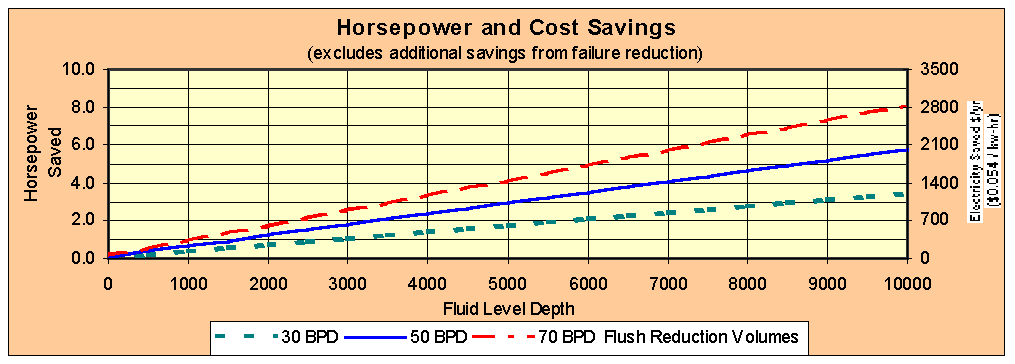
EXAMPLE: A well with a needle valve sidestream installation was tested and yielded a rate of 85 BPD (Barrels per Day) with an average wellhead pressure of 110 psi and a casing pressure of 80 psi. A SFR was installed and the flush was tested at 10 BPD. The pumping fluid level is around 5000 feet.
Using the equation above, the Qactual would be +/- 40 bpd = 75 bpd * {(110-80)/110}**0.5 = 75*0.52 Using the chart above, the electricity savings would be around 2.4 Horsepower and $1000/yr/well.
SUMMARY
Omega Technologies Inc. provides an economical Sidestream Flush Restrictor, patent pending (SFR), that may significantly reduce pumping energy usage, improve the reliability of a continuous chemical injection system, and reduce pumping failures. This simple device would be used in lieu of the conventional needle valve choke arrangement and has been proven successful in field operations.